 SASHA ALEXANDRA NOSOVA
Creative Leadership Studio
Developing Creative Leaders for Business, Economics & Management
Creative Leadership Studio is an in-depth professional and leadership development program designed specifically for students in Business, Economics and Management.
Using contemporary art practices and specially designed creative challenges, the program helps students develop capabilities that are becoming increasingly important in today’s business environment: strategic thinking, opportunity recognition, decision-making under uncertainty, unconventional idea generation, experimentation, collaboration, and the ability to turn ideas into action.
Business education traditionally teaches students to analyse data, assess risk and identify rational solutions. Creative Leadership Studio adds another way of thinking: the ability to ask unconventional questions, notice what lies beyond the obvious, work with ambiguity, and identify opportunities where others may see a dead end.
Contemporary art and its principles provide a practical environment in which to develop this kind of thinking.
Participants encounter creative challenges where there is no single correct answer. They investigate, experiment, make decisions, encounter unexpected outcomes, reconsider their strategies and work collaboratively.
At the heart of Creative Leadership Studio is one question:
How can we learn not only to solve existing problems, but also to recognise opportunities that no one has noticed yet?
1. Program Vision
Creative Leadership Studio views the university as a place that prepares not only specialists, but also future leaders, entrepreneurs, managers and people capable of creating meaningful change.
The business environment is becoming increasingly complex. Technological change, artificial intelligence, global competition, new models of consumption, social transformation and economic uncertainty require future professionals to bring much more than the ability to apply established models.
They need to be able to:
see → analyse → experiment → decide → act
These capabilities are at the heart of the program.
Contemporary art provides a unique environment for developing them. Artistic practice rarely offers a predetermined outcome. It requires people to establish their own direction, make choices, evaluate results and decide what to do next.
This process has direct parallels with entrepreneurship, management and innovation.
Creative Leadership Studio uses the artistic process as a space in which students can practise the ways of thinking required of future business leaders.
The vision of the program is to help develop a generation of professionals who are able not only to work effectively within existing systems, but also to imagine new possibilities, turn ideas into reality and lead teams through complexity and change.
2. Why It Matters
A strong business education gives students analytical foundations needed to understand organisations and economies. But today’s workplace increasingly requires graduates to combine specialist knowledge with transferable capabilities.
Australian higher-education and industry bodies have identified creativity, critical and analytical thinking, problem-solving, leadership, communication, interpersonal skills and adaptability as important capabilities for innovation and employment. (Universities Australia)
Employers also distinguish between knowing something and being able to apply knowledge in changing circumstances. Recent Australian employer data continues to highlight adaptive, collaborative and innovation-related capabilities alongside technical and professional knowledge. (Universities Australia)
This creates an important opportunity for business schools where creative practice can become a laboratory for leadership.
Artists routinely work with incomplete information, constraints, experimentation, failure, ambiguity and unexpected outcomes. They make decisions without always knowing the final result. They observe closely, test ideas, revise, communicate meaning and respond to what emerges.
These are not only artistic behaviours.
They are leadership behaviours.
Design-thinking education has similarly been used to develop interdisciplinary, experiential and adaptive approaches to complex problems, helping students prepare for workplaces in which the nature of work continues to change. (World Economic Forum)
Creative practice offers a different form of learning: learning through making.
When students create something new, they must make decisions without having complete information, test hypotheses, evaluate outcomes and sometimes start again.
This closely reflects the way entrepreneurs, managers and leaders operate in real-world business environments.
Contemporary art is particularly valuable in this context because it allows students to temporarily step outside the familiar logic of finding the “right answer” and learn to work with questions, possibilities and uncertainty.
Creative Leadership Studio does not replace traditional business education. It complements and enriches it by providing experiences that help students develop the thinking and behaviours required to lead in a complex and constantly changing environment.
The program does not require prior artistic skills and is not an art course.
It is a creative professional development program that uses contemporary art as a tool for developing leadership, entrepreneurial and professional capabilities.

3. Program Objectives
Creative Leadership Studio is designed to help students develop the ability to:
- think differently and recognise alternative possibilities;
- analyse problems from multiple perspectives;
- ask stronger and more unexpected questions;
- generate and develop new ideas;
- make decisions with incomplete information;
- work with uncertainty and ambiguity;
- experiment and test hypotheses;
- see mistakes as sources of information and learning;
- move from ideas to action;
- solve unfamiliar and complex problems;
- develop strategic and systems thinking;
- collaborate effectively with people who have different perspectives and approaches;
- listen, communicate, persuade and build dialogue;
- develop initiative and entrepreneurial thinking;
- identify and develop their own leadership style;
- create conditions in which other team members can also demonstrate initiative and creativity.
The central purpose of the program is not to teach students one particular style of behaviour or leadership.
It is to develop their capacity to think independently, make decisions, create opportunities and lead others through complexity and change.
4. Who Is the Program For?
Creative Leadership Studio is particularly suited to students across Business, Economics and Management disciplines.
Business Students
For students studying business, commerce, finance, marketing and related disciplines who want to develop capabilities beyond academic knowledge.
Economics Students
For students who need to recognise connections, interpret complex systems and consider economic and social processes from multiple perspectives.
Management Students
For future managers who will work with people, make decisions, manage change and build effective teams.
Entrepreneurship & Innovation Students
For students developing entrepreneurial capabilities and interested in creative problem-solving, experimentation, opportunity recognition and innovation.
MBA & Postgraduate Students
For students with existing professional experience who want to explore new approaches to leadership, innovation and strategic thinking.
Student Leadership Programs
For university initiatives focused on developing future leaders, student representatives, emerging professionals and student community leaders.
Business Societies & Student Communities
For student business societies, entrepreneurship clubs, innovation groups and interdisciplinary teams.
Creative Leadership Studio can also be adapted for a specific course, faculty, Business School, student program or university-wide strategic initiative.
5. Program Structure
Creative Leadership Studio is built around practical experience gained through creative practice.
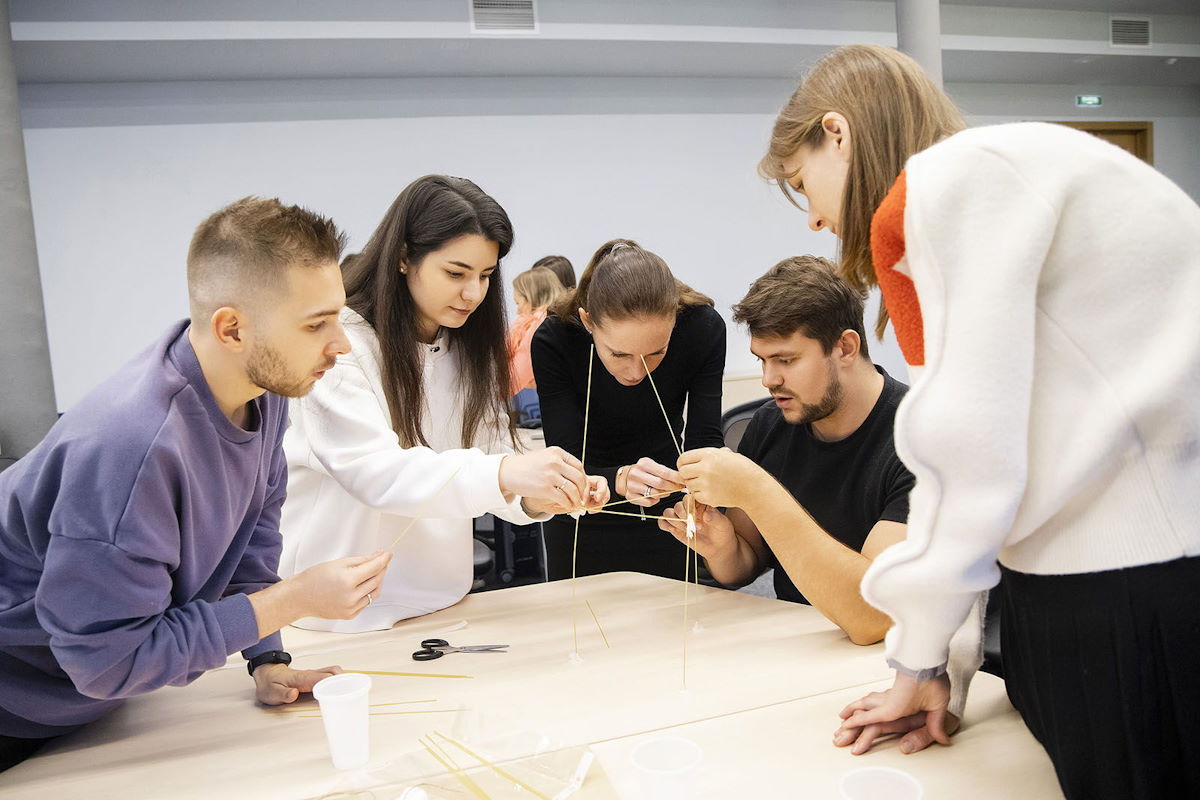
Rather than a series of lectures, participants move through a sequence of creative challenges and situations requiring observation, analysis, decision-making, experimentation and collaboration to find effective solutions.
Depending on the objectives of the program, creative practice may explore:
- creative problem-solving;
- strategic thinking;
- opportunity recognition;
- decision-making;
- innovation;
- entrepreneurial thinking;
- collaboration;
- communication;
- leadership under uncertainty;
- adaptive thinking.
Participants may work individually, in pairs or in teams, moving through several stages:
Challenge → Explore → Experiment → Create → Reflect → Decide
This approach allows students not simply to discuss leadership capabilities, but to observe them in action and develop their own ways of making decisions and working effectively with others.
The format, duration, creative processes, themes, group size and intended outcomes can all be adapted to the specific audience and objectives of the university.
The program can be delivered as:
- a one-day intensive;
- a leadership workshop;
- a series of practical sessions;
- part of an entrepreneurship or innovation program;
- an extension to an existing business curriculum;
- a program for student societies;
- a transition or orientation program for first-year students;
- an interdisciplinary project;
- a longer-term creative leadership development program.
Examples of previous programs are available on request.

6. Expected Outcomes
For Students as Future Professionals
Creative Leadership Studio helps students develop professional thinking through the experience of creating, experimenting and making decisions.
Participants can develop:
- the ability to see opportunities beyond the obvious;
- confidence in developing and expressing their own ideas;
- creative approaches to problem-solving;
- strategic and systems thinking;
- the ability to make decisions with incomplete information;
- adaptability and resilience in the face of change;
- willingness to experiment;
- the ability to learn quickly from the outcomes of their actions;
- teamwork and collaboration skills;
- effective communication and persuasion;
- initiative;
- entrepreneurial thinking;
- the ability to turn ideas into action;
- a more conscious understanding of their own leadership style.
The goal is to help students move towards a more mature professional mindset:
“I can investigate a problem, assess opportunities, test possible solutions and take responsibility for the next step.”
For the University as an Institution
The program can help universities extend and enrich their existing educational offering by:
- complementing traditional business education with creative practice;
- developing transferable skills valued by employers;
- introducing innovative approaches to leadership development;
- strengthening the connection between academic learning and real-world professional challenges;
- supporting entrepreneurship and innovation initiatives;
- creating opportunities for interdisciplinary collaboration;
- increasing student engagement;
- creating memorable and distinctive educational experiences;
- demonstrating an innovative approach to preparing future professionals.
For a Business School or Faculty of Economics and Management, the program can become a distinctive element of the student experience — connecting business thinking with creative practice.
For Business and the Professional Community
University graduates enter organisations where they will need to work with change, uncertainty, competition and increasingly complex challenges.
Businesses need not only professionals who can analyse existing data, but also people who can recognise what could be created in the future.
Creative Leadership Studio develops precisely this capacity.
Through collaborative creative challenges, students learn to:
- consider different perspectives;
- identify unexpected connections;
- negotiate and reach agreement;
- distribute roles;
- make decisions;
- test ideas;
- respond constructively to failure;
- create outcomes together.
These capabilities have direct relevance to future careers in management, consulting, marketing, entrepreneurship, finance, innovation and many other fields.
For Society: Developing a New Generation of Leaders
Economic development depends not only on technology and capital, but also on people’s ability to generate new ideas and develop unconventional solutions.
Future entrepreneurs, managers, economists and business leaders will make decisions that affect not only companies, but also employees, consumers and communities.
The program approaches creativity as both a professional and social capacity: not simply the ability to adapt to change, but the ability to participate in shaping it.
In the long term, the program aims to contribute to a generation of Australian professionals who can think independently, act responsibly, create new opportunities and lead others through periods of uncertainty, crisis and change.

7. Partnership Opportunities
Creative Leadership Studio can be developed in collaboration with different areas of a university.
Business Schools & Faculties
Integrating creative leadership into existing business, management, economics and commerce programs.
Leadership Development
A practical creative component within existing student leadership development initiatives.
Entrepreneurship & Innovation
Creative practices for developing opportunity recognition, idea generation, experimentation and entrepreneurial thinking.
Employability & Careers
Developing capabilities increasingly valued by employers, including creative thinking, problem-solving, adaptability, communication and collaboration.
MBA & Executive Education
Intensive creative formats focused on strategic thinking, innovation and leadership.
Marketing & Consumer Behaviour
Exploring visual thinking, interpretation, cultural codes and the ability to identify new perspectives on consumer behaviour and demand.
Economics
Creative approaches to exploring complex systems, alternative scenarios and the connections between economic and social processes.
Student Business Societies
Creative leadership events and workshops for entrepreneurship clubs, consulting groups, finance societies and other student organisations.
Corporate Partnerships
Joint university–business programs in which students address real-world professional challenges through creative approaches.
Research Partnerships
Opportunities to contribute to research into arts-based learning, creative thinking, leadership development, employability, innovation and student experience.
Universities can also commission a bespoke Creative Leadership Studio program connected to a specific faculty, business project, professional capability or strategic priority.
8. Bring Creative Leadership Studio to Your University
What happens when future business leaders are given the opportunity to step beyond familiar ways of thinking?
What happens when they encounter a challenge with no ready-made answer — and have to determine their own direction, test an idea, make a decision and anticipate the outcome?
Creative Leadership Studio transforms these situations into opportunities for practical learning.
It is not a lecture about leadership.
It is not a management training course.
And it is not an art course.
It is a practical laboratory for creative thinking, where contemporary art becomes a tool for developing the next generation of leaders in business, economics and management.
Whether you are looking for a one-off leadership intensive, an entrepreneurship seminar, an extension to an existing business curriculum, a program for a student society, or a longer-term partnership, Creative Leadership Studio can be tailored to the specific context of your university and the professional goals of its students.
Let’s make a Creative Leadership Studio in your university
Contact us to discuss your students, professional capabilities, strategic priorities and the most effective format for your university.
Examples of previously executed programs are available on request.